
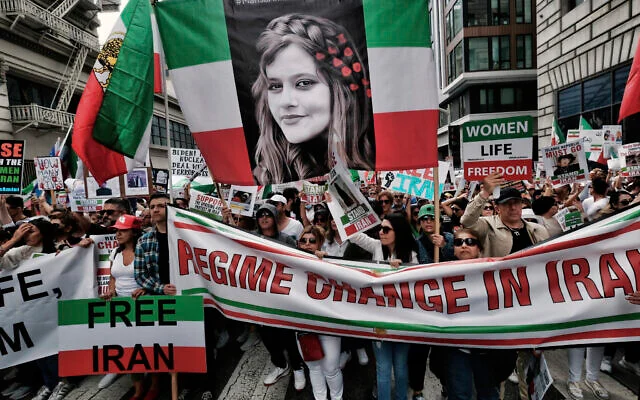
US demonstrators carry a large photo of Mahsa Amini during a protest against the Iranian regime, in Los Angeles, on October 22, 2022, following the death of Amini in the custody of the Islamic Republic’s notorious “morality police.” (AP Photo/Richard Vogel)
The women’s population of Iran was reported at 49.16 % in 2023, according to the World Bank collection of development indicators, compiled from officially recognized sources.
Iran, a nation of rich cultural heritage and complex modern challenges, presents a compelling case study in demographics and human rights. With its population dynamics shifting dramatically over recent decades and women’s rights remaining at the forefront of international attention, understanding Iran’s current situation requires examining both the numbers and the stories behind them.
Population Demographics: A Nation in Transition
Iran’s population tells a story of remarkable demographic change. According to World Bank data, women comprise 49.16% of Iran’s total population as of 2023, representing approximately half of the country’s estimated 86+ million inhabitants. This near-equal gender distribution places Iran in line with global demographic patterns, yet the lived experiences of Iranian women remain starkly different from their numerical representation might suggest.
The country has undergone one of the world’s most dramatic fertility transitions. Iran’s fertility rate plummeted from 7.3 children per woman in 1960 to just 1.7 children per woman by 2021, reflecting broader socioeconomic changes including urbanization, education expansion, and women’s evolving roles in society. This demographic shift has created a large youth population that came of age during a period of increasing social restrictions, contributing to the tensions that would later explode into nationwide protests.
The Current State of Women’s Rights in Iran
The Islamic Republic of Iran maintains one of the world’s most restrictive legal frameworks governing women’s lives. From mandatory hijab laws to restrictions on travel, employment, and public participation, Iranian women face systematic legal discrimination that affects every aspect of their daily existence.
The Turning Point: Mahsa Amini and the “Woman, Life, Freedom” Movement
The landscape of women’s rights discourse in Iran was forever changed on September 14, 2022, when 22-year-old Kurdish Iranian woman Mahsa Amini was arrested by the Guidance Patrol for wearing an “improper hijab”. Amini collapsed at a detention center and died three days later while in police custody, with a UN investigation later finding that Iran was responsible for the “physical violence” that led to her death.
Her killing sparked the “Woman, Life, Freedom” uprisings, with women defiantly removing their hijabs at her funeral and feminist groups calling for protests. The movement spread globally, bringing unprecedented international attention to the plight of Iranian women and inspiring solidarity movements worldwide.
33 High-Profile Cases Highlighting Women’s Rights Violations in Iran
While comprehensive documentation of individual cases remains challenging due to Iran’s restrictions on press freedom and civil society, the following represents a compilation of significant cases that have drawn international attention:
Executions and Morality Police Detentions
- Mahsa Amini (2022) – The 22-year-old Kurdish woman whose death in police custody sparked nationwide protests
- Niloufar Hamedi – Journalist who broke the story of Mahsa Amini’s hospitalization, later imprisoned
- Elaheh Mohammadi – Journalist who covered Amini’s funeral, subsequently detained and charged
- Nasrin Sotoudeh – Prominent human rights lawyer repeatedly imprisoned for defending women’s rights
- Narges Mohammadi – Nobel Peace Prize winner imprisoned for her women’s rights activism
- Golrokh Iraee – Writer and activist repeatedly detained for her advocacy work
- Atena Daemi – Civil rights activist serving lengthy prison sentence
- Yasaman Aryani – Women’s rights activist imprisoned for protesting mandatory hijab
- Monireh Arabshahi – Mother of Yasaman Aryani, also imprisoned for women’s rights activities
- Mojgan Keshavarz – Women’s rights activist and journalist detained multiple times
Recent Executions of Women
According to UN data, at least 31 women were executed in Iran in 2024, representing the highest number in at least 15 years. While specific names are often withheld due to security concerns for families, these cases represent a broader pattern of using capital punishment against women, often in cases where their male counterparts might receive lesser sentences.
Protest-Related Cases
- Armita Geravand – Teenager who fell into a coma after an alleged confrontation with morality police in 2023
- Nika Shakarami – 16-year-old protester who disappeared during demonstrations and was later found dead
- Sarina Esmailzadeh – 16-year-old killed during protests in Karaj
- Hadis Najafi – 20-year-old shot during protests in Karaj
- Mahsa Mogoi – Protester killed during demonstrations
- Minoo Majidi – 62-year-old protester shot during demonstrations
- Ghazaleh Chelavi – University student killed during campus protests
- Asra Panahi – High school student allegedly beaten to death for refusing to sing pro-government anthem
Academic and Professional Women
- Fatemeh Sepehri – Academic and activist detained for her political commentary
- Faezeh Hashemi – Journalist and women’s rights advocate, daughter of former president
- Shiva Nazar Ahari – Journalist and human rights activist imprisoned multiple times
- Jila Baniyaghoob – Journalist detained for her reporting on women’s issues
- Parvin Ardalan – Women’s rights activist and award winner denied permission to leave Iran
Legal Professionals and Advocates
- Shahindokht Molaverdi – Former government official advocating for women’s rights
- Mahdieh Golrou – Lawyer defending women’s rights cases
- Zahra Zehtabchi – Documentary filmmaker facing restrictions for her work on women’s issues
Cultural and Sports Figures
- Elnaz Rekabi – Rock climber who competed without hijab at international competition
- Taraneh Alidoosti – Actress who faced restrictions for supporting protests
- Niloofar Bayani – Environmental activist sentenced to lengthy prison term
Lesser-Known but Significant Cases
- Sepideh Gholian – Labor rights activist imprisoned for her advocacy work
- Sahar Kazemi – Student activist detained during university protests
- Maryam Akbari Monfared – Political prisoner serving lengthy sentence for family connections to opposition
- Zeinab Jalalian – Kurdish political prisoner serving life sentence
The Ongoing Struggle: Current Conditions
Two years after Mahsa Amini’s death, Iranian authorities’ brutal repression against women has only continued. Under the previous administration, women faced numerous challenges, including increased enforcement of dress codes, reduced political participation, economic barriers, and restricted access to reproductive health services.
Iranian authorities launched a new nationwide campaign called the “Noor Plan” in April 2024, which human rights organizations describe as further intensifying restrictions on women’s dress and behavior in public spaces.
International Response and Future Outlook
The international community has responded with sanctions, diplomatic pressure, and solidarity movements. However, the fundamental challenge remains: how to support Iranian women’s rights while avoiding measures that might further harm the Iranian people.
The demographic reality that women comprise nearly half of Iran’s population, combined with their high levels of education and professional aspirations, creates an inherent tension with the current legal and social restrictions. This tension, as demonstrated by the “Woman, Life, Freedom” movement, continues to simmer beneath the surface of Iranian society.
Iran’s demographic composition reveals a country where women represent nearly half the population yet face systematic discrimination in law and practice. The 33 cases highlighted here represent merely the visible portion of a much larger struggle for basic human rights and dignity. While the international spotlight has dimmed since the peak of the protests, the fundamental issues that drove millions to the streets remain unresolved.
The courage of Iranian women, from Mahsa Amini to the countless unnamed protesters who continue to resist, serves as a powerful reminder that demographic numbers only tell part of the story. Behind every statistic is a human being demanding the right to live with dignity, freedom, and equality. Their struggle continues, and their voices demand to be heard.
This analysis is based on available information as of June 2025. The situation for women’s rights in Iran remains fluid and often dangerous for those who speak out. Many cases go unreported due to security concerns and restrictions on press freedom.
From Monarchy to Theocracy: Iran’s Transformation and Global Impact
How Iran’s Legal System and Society Changed Since the Shah
Overview
Iran’s transformation from a Western-aligned monarchy under the Shah to an Islamic theocracy represents one of the most dramatic political upheavals of the modern era. This comprehensive analysis examines how legal systems, social structures, and international relationships fundamentally changed after 1979, with lasting implications for the Middle East and global politics.
Understanding Iran’s journey helps explain current regional conflicts, the rise of proxy warfare, and why the country remains central to debates about nuclear proliferation, terrorism, and Middle Eastern stability.
I. Setting the Stage: Iran Before the Revolution
Historical Context
Iran, historically known as Persia, boasts one of the world’s oldest civilizations. For centuries, it was ruled by various dynasties, with the Qajar dynasty (1789-1925) being the last traditional Persian monarchy. In 1925, Reza Shah Pahlavi seized power, establishing the Pahlavi dynasty that would rule Iran until 1979.
Mohammad Reza Shah Pahlavi ascended to the throne in 1941 when his father was forced to abdicate due to his pro-German sympathies during World War II. The young Shah would rule for 38 years, overseeing a period of rapid modernization and increasing tensions that ultimately led to his downfall.
II. The Shah’s Modernization Drive (1941-1979)
Legal and Social Reforms
The Shah implemented sweeping changes aimed at modernizing Iran along Western lines:
Key Legal Reforms:
- Secular Legal System: Replaced traditional Islamic courts with European-style civil law based on French and Belgian models
- Women’s Rights: The Family Protection Law (1967, revised 1975) gave women unprecedented rights in marriage, divorce, and custody
- Voting Rights: Women gained suffrage in 1963, a radical change in the Middle East context
- Land Reform: Broke up large feudal estates and redistributed land to peasants
- Education Expansion: Established new secular schools and universities throughout the country
The White Revolution
Launched in 1963, the White Revolution was the Shah’s ambitious reform program that aimed to transform Iran into a modern, industrialized nation. While it achieved significant economic growth and social progress, it also created deep social tensions:
- Rapid Urbanization: Millions moved from rural areas to cities, disrupting traditional communities
- Cultural Westernization: Western dress, music, and lifestyle became prevalent among the urban elite
- Economic Inequality: While some prospered, many rural poor felt left behind
- Religious Opposition: The clergy viewed these changes as threats to Islamic values and their authority
The Modernization Paradox: The Shah’s reforms, while progressive by Western standards, alienated traditional segments of Iranian society. The rapid pace of change, combined with authoritarian rule and the suppression of political opposition through SAVAK (the secret police), created conditions for revolutionary upheaval.
III. The 1979 Islamic Revolution
The Collapse of the Monarchy
By the late 1970s, various factors converged to destabilize the Shah’s regime:
- Economic Problems: High inflation and unemployment despite oil wealth
- Political Repression: SAVAK’s brutal suppression of dissent created widespread resentment
- Religious Opposition: Ayatollah Khomeini’s exile only amplified his influence
- Cultural Backlash: Many Iranians felt their traditional values were under attack
- International Pressure: President Carter’s human rights emphasis weakened U.S. support for the Shah
Mass protests, strikes, and civil unrest eventually forced the Shah to flee Iran in January 1979. Ayatollah Khomeini returned from exile in February, and by April, Iranians had voted to establish an Islamic Republic.
The Revolutionary Transformation
The revolution brought immediate and dramatic changes:
- Abolition of the Monarchy: The 2,500-year tradition of Persian kingship ended
- Islamic Governance: A theocratic system based on Khomeini’s concept of velayat-e faqih (rule of the jurisprudent)
- Legal System Overhaul: Secular laws were replaced with Islamic sharia
- Foreign Policy Reversal: From a U.S. ally to “Death to America” as a national slogan
IV. The Islamic Republic’s Legal and Social System
Constitutional Framework
The 1979 Constitution (amended in 1989) established a unique system blending democratic elements with clerical authority:
- Supreme Leader: The ultimate authority, currently Ali Khamenei since 1989
- Guardian Council: 12 members who vet all candidates and legislation for Islamic compliance
- Elected Positions: President and Parliament (Majles) chosen by popular vote
- Dual Power Structure: Elected officials must operate within limits set by unelected clerical authorities
Legal System Changes
The judiciary was completely restructured according to Islamic principles:
Major Legal Changes:
- Sharia Implementation: Islamic law became the basis for all legislation
- Religious Courts: Islamic judges replaced Western-trained legal professionals
- Islamic Punishments: Introduction of hudud (Quranic punishments) including amputation and stoning
- Revolutionary Courts: Special tribunals for political crimes and “corruption on earth”
V. Impact on Iranian Society
Women’s Rights and Status
The revolution dramatically reversed women’s legal status:
- Mandatory Hijab: Imposed in 1981, making Iran one of the few countries requiring headscarves
- Legal Restrictions: Women need male guardian permission for travel, work, and many legal matters
- Educational Paradox: Despite restrictions, over 60% of university students are women
- Professional Limitations: Barred from certain professions, including judgeships
The Hijab as Symbol: The mandatory headscarf became the most visible symbol of the Islamic Republic’s authority. Recent protests, including those following Mahsa Amini’s death in 2022, have centered on this requirement, making it a focal point of resistance to the regime.
Top Ten Ways Iran’s System Restricts Women’s Rights
The Islamic Republic’s approach to women’s rights reflects a complex interplay of religious interpretation, political control, and social conservatism. Here are the primary reasons the system maintains restrictions on women:
1. Religious Interpretation of Islamic Law The regime interprets Islamic sharia as requiring gender segregation and male guardianship. This interpretation, while disputed by many Islamic scholars globally, forms the legal foundation for restricting women’s autonomy in public and private life.
2. Political Control and Social Order Women’s dress and behavior serve as visible markers of the regime’s authority. Controlling women’s appearance and movement demonstrates state power and tests public compliance with revolutionary ideology.
3. Traditional Gender Role Ideology The system promotes women’s primary role as mothers and wives, arguing that this serves family stability and Islamic values. This ideological framework justifies limiting women’s economic and social independence.
4. Male Guardian System (Velayat-e Mard) Islamic jurisprudence as interpreted by Iran requires male guardians (fathers, husbands, or male relatives) to approve major decisions for women, from travel to marriage to certain medical procedures.
5. Morality Police Enforcement The Gasht-e Ershad (morality police) actively enforce dress codes and gender segregation rules, making women’s compliance a matter of avoiding arrest, fines, or worse consequences.
6. Legal Testimony and Inheritance Discrimination Under Iran’s interpretation of Islamic law, a woman’s testimony in court is worth half that of a man’s in many cases, and women inherit half of what their male siblings receive, institutionalizing gender inequality.
7. Control of Public Space Women are banned from many public venues including sports stadiums, certain parks, and beaches. This limitation serves to maintain gender segregation and restrict women’s participation in public life.
8. Educational and Professional Restrictions Despite high female university enrollment, women are barred from studying certain subjects (like nuclear physics) and working in specific professions (like judgeships), limiting their economic independence.
9. Marriage and Divorce Inequality Men can divorce women easily and take multiple wives, while women face significant legal barriers to divorce and lose custody of children over age 7 (boys) or 9 (girls) in most cases.
10. Resistance to Western Influence The regime frames women’s rights as Western cultural imperialism, arguing that restricting women preserves authentic Islamic and Iranian values against foreign influence and cultural invasion.
These restrictions exist despite Iran having one of the Middle East’s most educated female populations, with women comprising over 60% of university students. This contradiction between women’s educational achievements and legal limitations has become a source of ongoing tension and protest within Iranian society.
Religious Minorities and Freedoms
The Constitution recognizes only certain religious minorities:
- Protected Minorities: Christians, Jews, and Zoroastrians have limited rights
- Sunni Muslims: Face discrimination despite comprising 5-10% of the population
- Baháʼí Faith: Not recognized; followers face severe persecution
- Apostasy Laws: Leaving Islam is theoretically punishable by death
Media and Expression
Free speech and press freedom were severely curtailed:
- Censorship: Books, films, and music must conform to Islamic standards
- Internet Restrictions: Many websites and social media platforms are blocked
- Journalist Imprisonment: Reporters and bloggers face arrest for “propaganda against the state”
- Underground Culture: A vibrant underground arts scene exists despite restrictions
VI. Iran’s Regional Strategy and Proxy Network
The “Axis of Resistance”
Iran developed a sophisticated network of proxy groups to project power across the Middle East:
Major Proxy Relationships:
- Hezbollah (Lebanon): Created in the 1980s, now a major political and military force
- Hamas (Gaza): Receives weapons and training despite ideological differences
- Houthis (Yemen): Zaydi rebels fighting Saudi-backed government
- Iraqi Militias: Various Shia groups with Iranian backing
- Syrian Support: Military aid to Bashar al-Assad’s regime
Strategic Objectives
Iran’s proxy strategy serves multiple purposes:
- Regional Influence: Extending Iranian power without direct military confrontation
- Israeli Deterrence: Creating a “ring of fire” around Israel
- Saudi Competition: Challenging Saudi Arabia’s regional leadership
- U.S. Pressure: Raising costs of American involvement in the region
VII. Nuclear Program and International Relations
Nuclear Development
Iran’s nuclear program has been central to international tensions:
- Peaceful Claims: Iran insists its program is for civilian energy purposes
- International Suspicion: Uranium enrichment levels suggest potential weapons capability
- Negotiation Cycles: The 2015 JCPOA temporarily limited the program
- Current Status: Iran has exceeded JCPOA limits since U.S. withdrawal in 2018
Sanctions and Economic Impact
Decades of sanctions have significantly impacted Iranian society:
- Oil Exports: Reduced from 3.8 million barrels/day in 2017 to under 1 million
- Banking Isolation: Difficulty accessing international financial systems
- Currency Collapse: The rial has lost over 80% of its value since 2018
- Brain Drain: Educated Iranians emigrate at high rates
VIII. Iran’s Campaign Against American Interests
Four Decades of Anti-American Operations
Since 1979, Iran has conducted numerous operations against American interests:
Major Anti-U.S. Incidents:
1979: U.S. Embassy Hostage Crisis – 66 Americans held for 444 days, establishing Iran’s anti-American credentials
1983: Beirut Marine Barracks Bombing – 241 U.S. servicemen killed by Hezbollah truck bomb
1996: Khobar Towers Bombing – 19 U.S. Airmen killed in Saudi Arabia by Iranian-backed group
2003-2011: Iraq EFP Attacks – Hundreds of U.S. soldiers killed by Iranian-supplied explosively formed penetrators
2020: Al-Asad Air Base Attack – First direct Iranian missile strike on U.S. forces
2024: Assassination Plots – IRGC-linked attempts to kill former U.S. officials on American soil
IX. Contemporary Challenges and Resistance
Internal Opposition
Despite authoritarian control, Iranian civil society continues to resist:
- Periodic Protests: 2009 Green Movement, 2017-2019 economic protests, 2022-2023 women’s uprising
- Youth Dissent: 70% of the population is under 35 and increasingly secular
- Women’s Resistance: Ongoing challenges to mandatory hijab laws
- Labor Strikes: Economic hardship fuels worker protests
Regional Tensions
Iran’s policies have created numerous regional flashpoints:
- Israel-Iran Shadow War: Ongoing covert operations and proxy conflicts
- Saudi-Iran Rivalry: Competition for Islamic leadership and regional influence
- Syrian Civil War: Iranian support for Assad against Sunni rebels
- Yemen Conflict: Proxy war between Iranian-backed Houthis and Saudi coalition
X. Conclusion: Iran’s Dual Reality
Iran today embodies a fundamental contradiction. On one hand, it has become a sophisticated regional power with advanced military capabilities, a well-educated population, and significant natural resources. On the other hand, it remains internationally isolated, economically constrained, and internally divided between a religious government and an increasingly secular society.
Key Takeaways:
- Transformation Complete: Iran has successfully transitioned from a secular monarchy to a functioning theocracy
- Regional Power: Despite sanctions, Iran has become the Middle East’s most influential revisionist power
- Internal Contradictions: The gap between rulers and ruled continues to widen
- Global Impact: Iran’s actions affect energy markets, regional stability, and international security
Understanding Iran’s transformation helps explain many of today’s Middle Eastern conflicts and global security challenges. The country’s journey from the Shah’s modernization to the Islamic Republic’s theocracy demonstrates how rapidly political systems can change and how those changes can have lasting regional and global consequences.
As Iran continues to evolve, the tension between its revolutionary government and its educated, globally connected population suggests that further transformation may be inevitable. The question remains whether that change will come through reform or revolution, and what implications it will have for the Middle East and the world.
Key Events Timeline (1941-2025)
1941: Mohammad Reza Shah takes power
1963: White Revolution begins; women gain voting rights
1967: Family Protection Law expands women’s rights
1979: Islamic Revolution; Shah overthrown, Islamic Republic established
1980-1988: Iran-Iraq War devastates both countries
1989: Khomeini dies; Khamenei becomes Supreme Leader
2009: Green Movement protests disputed election results
2015: JCPOA nuclear deal signed with world powers
2018: U.S. withdraws from JCPOA; reimposed sanctions
2022: Mahsa Amini’s death sparks nationwide protests
2024-2025: Ongoing regional conflicts and proxy activities
Sources and Further Reading
- Ervand Abrahamian, A History of Modern Iran
- Shirin Ebadi, Iran Awakening
- Ray Takeyh, Hidden Iran: Paradox and Power in the Islamic Republic
- Human Rights Watch Annual Reports on Iran
- U.S. State Department Country Reports on Human Rights Practices
- BBC Persian and Al Jazeera archives
- Congressional Research Service Reports on Iran
Bella World News
© 2025 Bella World News Proudly powered by WordPress